How Futures Are Taxed: What the 60/40 Rule Is Worth, Computed
My first futures 1099-B, what Section 1256's 60/40 split saves at each bracket, and the qualified-exchange catch the generic guides skip.
Part of the "Productionizing pysystemtrade" series
My systematic futures system, which trades only my own money, is up 42.9% since going live in November 2025, with a Sharpe ratio around 2.0 and a maximum drawdown of 8.4%. I lead with that for the usual reason: everything below comes from a real account. The 2025 numbers come from a real return, filed this spring; the 2026 numbers are the live year as it accrues, and that return gets filed next year.
This post is about the tax treatment, because it is the part of futures trading that surprised me most when I moved from thinking about it to filing it. US federal law taxes futures under Section 1256 of the tax code: 60% of your gains are taxed at long-term capital gains rates and 40% at ordinary rates, no matter how long you held anything. For someone in a high bracket, that works out to roughly $10,200 less federal tax per $100,000 of gains, every year, compared with earning the same profit trading stocks actively. And the paperwork runs in the opposite direction of what you'd expect: my system has made 1,130 fills across more than a hundred markets since going live, and when the first slice of that activity reached my tax return this spring, it arrived as one number on one form.
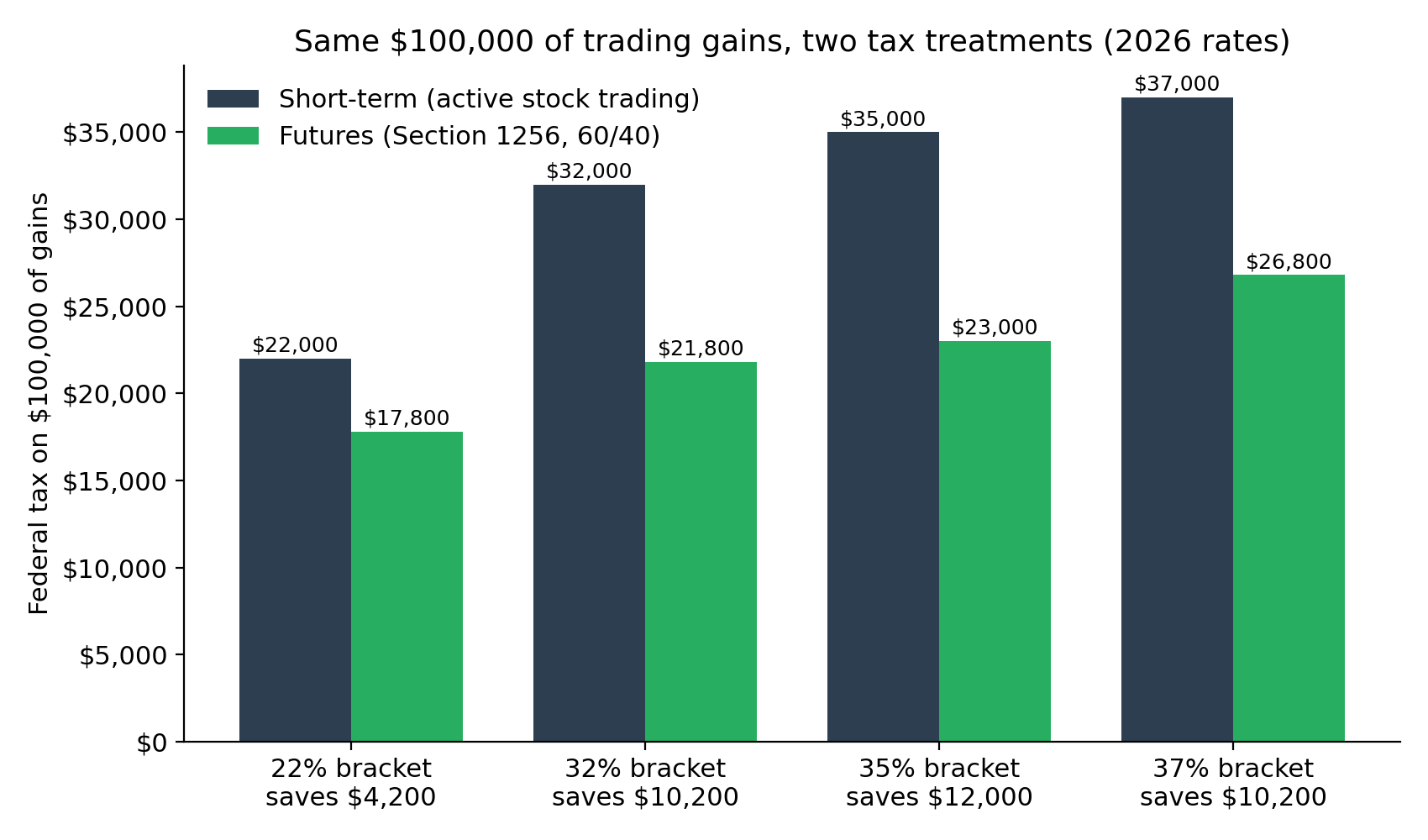
Federal tax on $100,000 of trading gains at 2026 rates. Left bars: gains taxed as short-term capital gains, which is what active stock trading produces. Right bars: the same gains under Section 1256's 60/40 split. The 3.8% net investment income tax applies equally to both sides and is left out.
The rest of this post works through where those numbers come from, what the filing actually looks like, and the caveats that the one-line summaries skip. The caveats section is the longest, on purpose.
How futures are taxed, in one paragraph
Section 1256 covers regulated futures contracts, along with certain foreign currency contracts and options on futures and broad-based indices. Two rules do all the work. First, mark-to-market: on December 31 your open positions are treated as if you sold them at that day's price, so each tax year captures that year's profit or loss in full, realized or not. Second, the 60/40 split: whatever that annual number is, 60% of it is taxed as long-term capital gain and 40% as short-term, regardless of holding period. You could hold a contract for an hour and 60% of the gain is still long-term. Individual stocks, ETFs, and equity options get none of this. Sell a stock you held for under a year and the whole gain is short-term, taxed at your ordinary rate.
1,130 fills, one line on the return
Some real numbers from my account. In 2026 so far the system has made 1,040 fills across 108 different futures markets: equity indices, bonds, short-term rates, FX, metals, energies, agricultural markets, crypto. Another 90 fills landed in the last two months of 2025 after go-live. Typical holding periods run from days to a few weeks. Every one of those trades would be a short-term event in stock-land.
Now imagine running the same activity through equities. Each round trip becomes a lot on Form 8949, with a date acquired, date sold, basis, and proceeds. Worse, the wash sale rule starts firing. A wash sale happens when you sell a security at a loss and buy a substantially identical one within 30 days on either side; the loss is disallowed and rolled into the basis of the new position. A mean-reverting or trend-following system that trades in and out of the same 108 markets all year would trip that rule constantly, and the basis adjustments chain through the whole year's records. Brokers compute most of this for you, but you still file it, and anything the broker's matching gets wrong is yours to untangle.
Under Section 1256 none of that machinery exists. Mark-to-market makes lot matching meaningless, and the wash sale rule simply does not apply to 1256 contracts. Interactive Brokers reports the year's Section 1256 activity as an aggregate profit-or-loss figure on the 1099-B. (Which contracts belong in that aggregate is a real question for anyone trading global markets; I get to it in the caveats.) That number goes on line 1 of Form 6781, the form splits it 40/60 onto lines 8 and 9, and those two lines flow to Schedule D. That's the filing. My 2025 return contained two months of live systematic trading, 90 fills, 20 markets, and the Section 1256 total occupied one line.
I want to be precise about what I'm claiming here, because "one line" sounds like marketing. The bookkeeping burden of the strategy still exists; it lives in the broker's mark-to-market accounting, where it belongs. What disappeared is the coupling between how much the system trades and how complicated my taxes are. A stock system that doubles its trading doubles its tax records. My system could double its turnover tomorrow and the return would still say one number.
What the 60/40 split is worth at each bracket
The value of the split depends on the gap between your ordinary rate and your long-term capital gains rate. Here is the arithmetic per $100,000 of net gains, at 2026 federal rates, by marginal bracket (the rate your last dollar of ordinary income pays):
| Marginal bracket | Long-term rate | Stock trading (all short-term) | Futures (60/40) | Saved |
|---|---|---|---|---|
| 22% | 15% | $22,000 | $17,800 | $4,200 |
| 32% | 15% | $32,000 | $21,800 | $10,200 |
| 35% | 15% | $35,000 | $23,000 | $12,000 |
| 37% | 20% | $37,000 | $26,800 | $10,200 |
The futures column is just 60% of the gain at the long-term rate plus 40% at the ordinary rate. At the top bracket the blended rate is 26.8%, which is why that number shows up in every article on this topic: against a 37% ordinary rate, the futures trader pays about 27% less federal tax on identical gains.
One detail I haven't seen written down elsewhere: the biggest absolute saving isn't at the top bracket. It's at 35%, where the ordinary rate is nearly at its maximum but the long-term rate is still 15% rather than 20%. The 60/40 split is worth $12,000 per $100,000 there, more than it's worth to someone in the 37% bracket. The fine print: the 20% long-term threshold sits inside the 35% ordinary bracket, so this holds for filers whose taxable income is below that threshold (a bit over half a million dollars for a single filer; it adjusts with inflation each year) and flips to the smaller saving above it.
I've normalized everything to $100,000 of gains rather than publishing my own dollar P&L, since the track record site reports in percentages. Scale the table to whatever gain size applies. The percentage the account earned this year is public: +46.2% year-to-date through early July.
Two omissions to keep the table honest. The 3.8% net investment income tax applies to both columns for high earners, so it changes the totals without changing the gap. And the long-term rate thresholds are set by taxable income, so a large trading gain can itself push you across one.
The caveats nobody puts in the pitch
The right comparison is other active strategies, and only those. A buy-and-hold index investor beats both columns of that table. They defer tax until they sell, pay only the long-term rate when they do, and may never sell at all. The 60/40 rule leaves that advantage intact. What it narrows is the penalty for strategies that inherently trade a lot, and managed futures is inherently such a strategy: the return stream comes from adjusting positions as trends and carry (the yield from simply holding a contract) change, and there is no buy-and-hold version of it to compare against.
Mark-to-market cuts both ways. Because December 31 crystallizes everything, you pay tax on unrealized gains and you cannot defer a good year into a lighter-income year. A stock trader can at least choose when to realize. I gave up that control entirely.
Loss years get the same treatment, with one useful twist. The 60/40 character applies to losses too. My first partial year was a live example: November 2025 finished +2.54%, December -4.70%, so calendar 2025 netted to roughly -2.3%. Box 11 of my 1099-B read -$3,640.09, the number Form 6781 splits 60/40. Capital losses only offset ordinary income up to $3,000 a year, but Section 1256 losses come with an option stocks don't have: an election (checkbox D on Form 6781) to carry the loss back up to three years against prior 1256 gains. I had no prior futures gains, so mine simply carried forward, where 2026's gains will absorb it. If you've traded futures profitably for years, though, the carryback turns a bad year into a refund of taxes already paid.
Only the futures P&L gets 60/40. A futures account is mostly cash, because margin is a small fraction of the notional exposure (the full value of the contracts the account controls). That spare cash is one of the quiet advantages of futures: it earns interest while it sits, and it stays available if I ever want to deploy capital elsewhere. But interest is ordinary income, taxed at your full rate. It arrives on its own 1099-INT: mine said $611.05 for 2025, and the payment dates show most of it accrued in the months before the trading system even went live, while the cash sat parked waiting. Interest needs no trading at all, and it gets none of the 60/40 treatment. The EUR cash posted as margin for the European contracts generated a worksheet of its own as well: $75.22 of currency gain for the year, ordinary income under Section 988. One futures account, three tax characters: 60/40 on the contracts, ordinary on the interest, ordinary on the currency moves. At current short rates a full year of interest is a meaningful slice of a futures account's total return. One thing my first consolidated 1099 made vivid is how little else there is on it: for a pure futures account, the entire form is one interest number and one futures aggregate, with zeros everywhere a stock account would have dividends and distributions. The 60/40 math above applies to the trading gains only.
States don't play along. The 60/40 split is a federal rule. Most states tax capital gains as ordinary income at a single rate, so the state portion of your bill looks the same whether the gains came from futures or stocks.
The fund wrapper is a different animal. If you hold managed futures through an ETF or mutual fund rather than an account trading futures directly, your taxation runs through fund distribution rules, often via an offshore subsidiary, and almost nothing in this post applies. That comparison deserves its own write-up.
Which exchanges qualify for Section 1256 (and which don't)
One caveat is big enough to get its own section, because in my book it is the catch that bites. Section 1256 requires the contract to trade on a qualified board or exchange. US exchanges qualify by definition. A foreign exchange qualifies only if the Treasury has issued a determination for it, and that list is short: ICE Futures Europe, LIFFE, Eurex Deutschland, ICE Futures Canada, the Bourse de Montréal, the Dubai Mercantile Exchange, and the European Energy Exchange.
I mapped my own trading against it. Of the 108 markets I've traded in 2026, 89 sit on US exchanges or Eurex and qualify. The other 19 do not: seven on Singapore's SGX, five on Osaka, two on Hong Kong's HKFE, three on Euronext Paris, one on Spain's MEFF, one on Nasdaq Stockholm. Gains on those fall back to normal capital-gain treatment, which at my holding periods means short-term, taxed at ordinary rates, and they belong outside the 60/40 aggregate.
My broker turns out to make this split itself: the 2025 worksheet for 1256 contracts included every US and Eurex position and silently omitted the one Euronext Paris contract I'd traded that year. The omission is the trap. Whatever the worksheet leaves out is still taxable; the broker just isn't reporting it for you, and finding and filing that remainder from the activity statements is your job. A global book carries this bucket by construction, and it is the strongest argument in this post for getting professional help.
What this changes about the allocation math
Most strategy comparisons happen pre-tax, and pre-tax comparisons quietly favor whatever trades least. Run the numbers after tax and the picture shifts. At the top bracket, a futures strategy keeps 73.2 cents of each marginal dollar of gain and an active stock strategy keeps 63. For the stock strategy to match the futures strategy after tax, it needs to earn about 16% more before tax, every year. That gap is on the order of what a whole allocation debate is usually about.
I run a systematic futures system, with my own capital, for the diversification; the tax treatment came along with the asset class. But when I compare my after-tax outcome against what the same effort and risk would have produced in an active equity strategy, Section 1256 is quietly one of the larger line items, and it required nothing from me except trading instruments Congress decided to treat kindly in 1981.
I'm a software engineer, not a tax professional, and this describes my own filing; nothing here is advice. The account is my own proprietary money: I'm not an investment adviser, I don't manage outside capital, and nothing here is an offer or solicitation of any kind. Plaintape LLC is registered with the CFTC as a Commodity Trading Advisor and is an NFA Member (NFA ID 0580378). The firm is not accepting client accounts. Registration and NFA membership do not imply that the CFTC or NFA has approved or endorsed the firm, its trading program, or the material on this site. Rates cited are 2026 federal rates and will change. Section 1256 has edges I've only brushed against here (straddles, hedging transactions, the deeper corners of Section 988) that can matter a lot in specific situations. Talk to a CPA who has seen a futures 1099-B before.
Sources: 26 U.S.C. §1256 (Cornell LII) · IRS Form 6781 · IRS Form 8949 · Green Trader Tax on Section 1256 contracts · Charles Schwab: Trader Taxes, Form 8949 & Section 1256 · Live track record: plaintape.fund